 Fitness Trak™
EMOM Vs AMRAP Vs Tabata, How Each Works And How To Log It
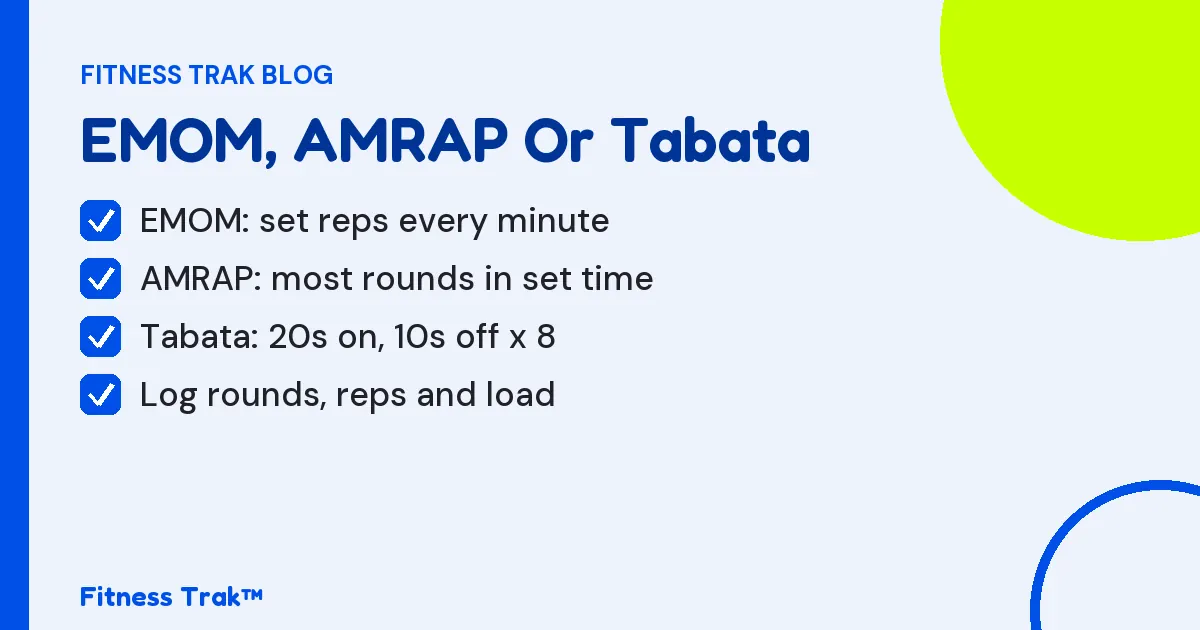
Interval workouts come with their own alphabet. EMOM, AMRAP, Tabata and "for time" all mix work and rest, but they work in different ways and they need different numbers in your log. If you log them all as "did a HIIT workout," you lose the chance to see progress.
This guide explains each format, when it fits, and what to write down.
If you are new to hard intervals, or you have a heart condition or another health concern, ask your doctor before starting high-intensity training.
EMOM: every minute on the minute
In an EMOM, you start a set number of reps at the top of every minute. Whatever time is left in the minute is your rest. When the next minute starts, you go again.
Example: EMOM for 10 minutes, 10 kettlebell swings. If the swings take 20 seconds, you rest 40.
- Good for: practicing a skill, steady pacing, and building work capacity with built-in rest.
- Gets harder when: you add reps, add weight, or extend the time.
What to log: total minutes, the exercise, reps per minute, the weight, and whether you finished every minute. If you failed a minute, note which one.
AMRAP: as many rounds as possible
In an AMRAP, you have a fixed time and do as many rounds of a circuit as you can. You rest only when you choose to.
Example: 12-minute AMRAP of 5 pull-ups, 10 push-ups and 15 air squats.
- Good for: pushing pace and testing work capacity.
- Gets harder when: you aim for more rounds in the same time, or add weight.
What to log: the time cap, the circuit with reps and weights, and your score as rounds plus extra reps. For example, "7 rounds + 8 reps." Repeat the same AMRAP a few weeks later and compare the score.
Tabata
Tabata comes from a 1996 study led by Izumi Tabata, published in Medicine and Science in Sports and Exercise. Subjects on a cycle ergometer did seven to eight bouts of 20 seconds at a very high intensity, about 170% of their VO2max, with 10 seconds of rest between bouts. They trained 5 days a week. After 6 weeks, the interval group's VO2max rose by 7 ml/kg/min and their anaerobic capacity rose by 28%. That group was small, with 7 people.
Today, "Tabata" usually means 8 rounds of 20 seconds on and 10 seconds off, 4 minutes total. Many gym versions use exercises like squats or burpees and are less intense than the original all-out cycling protocol.
- Good for: a short, very hard block.
- Gets harder when: you get more reps in each 20-second round.
What to log: the exercise, reps in each of the 8 rounds, and your lowest round. The lowest round is a useful score because it shows how well you hold up.
For Time
A "for time" workout has a fixed amount of work. You finish it as fast as you can.
Example: 50 burpees for time.
What to log: the work, any weights, and your finish time. A faster time on the same workout means progress.
Side By Side
- EMOM: fixed reps every minute, rest is what is left of the minute, score is minutes finished.
- AMRAP: fixed time, you choose when to rest, score is rounds plus reps.
- Tabata: 20 seconds on, 10 seconds off, 8 rounds, score is reps per round or the lowest round.
- For time: fixed work, you choose when to rest, score is time.
How intervals fit the weekly guidelines
The CDC recommends that adults get at least 150 minutes of moderate aerobic activity a week, or 75 minutes of vigorous activity, or an equal mix. Hard interval work often counts as vigorous. The CDC also recommends muscle-strengthening activity on at least 2 days a week that works all major muscle groups. Interval workouts with weights can help with both, but they are often short, so log the minutes to see your weekly total.
Common logging mistakes
- Logging only "HIIT, 20 minutes." Without the format and the score, you can't compare one session with the next.
- Changing the workout each time. Repeat a benchmark workout every few weeks so you have something to beat.
- Leaving out weights and scaling. Ten push-ups on your knees and ten from your toes are different workouts. Write down what you did.
- Forgetting how it felt. A one-line note or an effort rating helps explain a bad score. See how to log RPE and RIR.
For the rest of your log, see what to write in a workout log.
How Fitness Trak handles intervals
Fitness Trak has HIIT timers for AMRAP, EMOM, Tabata, for time and custom intervals. It tracks 44 cardio types, each with only its own fields, in miles or kilometers. AMRAP sets are marked on their own in your strength log, and supersets are supported, so circuits and lifting days live in the same history. If you book classes, it keeps the booking with a late-cancel reminder, and class packs warn you before they expire. See everything it tracks. Fitness Trak is coming soon to the App Store and Google Play.
Frequently asked questions
What is the difference between EMOM and AMRAP?
In an EMOM you do a fixed number of reps at the start of every minute and rest for the remainder. In an AMRAP you have a fixed time and do as many rounds of a circuit as you can, resting only when you choose.
How long is a Tabata workout?
A standard Tabata block is 8 rounds of 20 seconds of work and 10 seconds of rest, which is 4 minutes. The original 1996 study used seven to eight bouts on a cycle ergometer at a very high intensity.
Which is better for beginners, EMOM or AMRAP?
An EMOM can be easier to pace because the rest is built in. Choose reps you can finish with time to spare in each minute. Either way, ask your doctor before starting hard intervals if you have a health concern.
How do I track progress in HIIT workouts?
Repeat the same workout every few weeks and compare one score. Use rounds plus reps for an AMRAP, minutes finished for an EMOM, the lowest round for Tabata, and finish time for a workout done for time.
Sources
- Tabata I, et al. Effects of moderate-intensity endurance and high-intensity intermittent training on anaerobic capacity and VO2max. Medicine and Science in Sports and Exercise, 1996 (PubMed)
- CDC, Physical Activity Guidelines for Adults