 Fitness Trak™
What Is a Deload Week? How and When to Take One
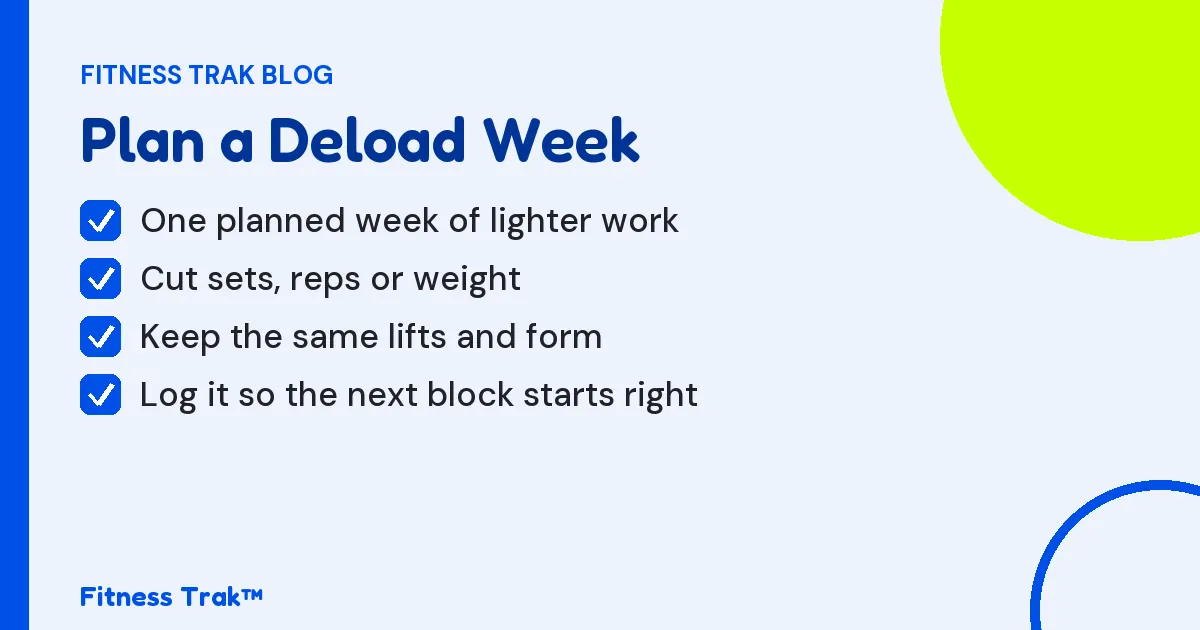
A deload week is a planned week of easier training, where you keep doing your usual lifts but cut the number of sets, the weight or both, so your body can recover before the next hard block. Most coaches keep it to about one week, then return to normal training.
Deloads are common in strength programs, but the research on them is still thin. A 2023 international consensus study of strength and physique coaches, led by researchers at Sheffield Hallam University, defined a deload as a period of reduced training stress meant to lower fatigue, help recovery and prepare you for the next block. A 2025 follow-up paper, "A Practical Approach to Deloading", turns that into practical guidance. Here is what a deload is, signs you might want one, how to plan it, and how to log it so it helps instead of stalling you.
What a deload is and is not
A deload is a lighter week inside a training plan. You still go to the gym. You still do the same movements. You just do less.
It is different from a week off. A week off means no training at all. A deload keeps the habit and the skill of the lifts going while lowering fatigue. Some lifters take full weeks off instead, and a 2024 study by Coleman and colleagues in PeerJ tested a full week off in the middle of a 9 week program. Muscle growth was not affected, though lower body strength gains were smaller in the group that stopped. That suggests a short break is not harmful, and a lighter week may keep strength moving better than stopping.
Why lifters deload
Hard training builds fatigue along with fitness. Over several weeks, fatigue can hide the strength you have built. A lighter week lets some of that fatigue clear. Common reasons people schedule one:
- To recover after a hard block of training
- To give sore joints and tendons a lighter load
- To fit training around a busy or stressful week
- To prepare for a test day or a meet
Signs you might need one
Some lifters deload on a fixed schedule, such as every fourth to eighth week. Others deload when their log tells them to. Signs worth watching:
- The same weights feel much harder than usual for a week or more
- Reps drop on several lifts at once
- Sleep gets worse or you feel worn down
- Aches in joints that do not clear between sessions
- Motivation to train falls off
One bad day is normal. A pattern across a week or two on several lifts is the signal. A log makes that pattern easy to see. See how to track gym progress for the numbers to watch.
Pain is different from fatigue. If you have sharp pain, pain that gets worse, or an injury, talk to a doctor or physical therapist instead of only deloading.
How to deload, three common ways
Cut sets
Keep the same weight and reps, but do fewer sets. If you normally do 4 sets of 8 on squats, do 2 sets of 8. This is the most common approach.
Cut weight
Keep the same sets and reps, but use a clearly lighter weight that leaves several reps in reserve. Form stays sharp, and fatigue drops.
Cut both
For a deeper rest, reduce sets and weight. This suits the end of a long, hard block.
Whichever you choose, keep the same exercises. You want to come back to normal training without relearning anything.
Steps
- Decide when the deload falls, either on a schedule or when your log shows a stall across several lifts.
- Choose how to cut. Fewer sets, lower weight or both.
- Write the deload week into your plan so you do not push hard by habit.
- Do the same lifts with the same form, at the lighter plan.
- Log every set as usual and mark the week as a deload.
- The week after, return to your normal working weights, or a small step above where you were.
- Compare the first two weeks after the deload to the two weeks before it.
How to log a deload
Logging a deload matters for two reasons. First, so your records do not look like you suddenly got weaker. Second, so you can tell whether the deload worked.
Mark the week clearly. Some people add a note to each session. If your app or spreadsheet supports it, tag the week as a deload so bests and charts are easy to read. When you come back, check whether your top sets match or beat the weeks before the deload.
Our guide on how to track progressive overload covers how deloads fit into a longer plan, and the double progression method is a common way to build back up after one.
How Fitness Trak handles deloads
Fitness Trak routines support schedule days, deloads, double progression and percent of your best, and it comes with 10 starter programs. During the week, the next set is prefilled from last time, so you can see your normal numbers and lighten them on purpose. PR tags and a chart for every exercise make it easy to compare before and after. A weekly goal with a week streak keeps rest days safe, so a light week does not cost you the streak. See the full list of what Fitness Trak tracks.
Frequently asked questions
How often should you take a deload week?
There is no single rule. Some programs schedule one every fourth to eighth week, and others add one only when progress stalls across several lifts. Watch your log for a week or two of dropping reps or rising effort at the same weights.
Should I still go to the gym during a deload week?
Yes, a deload keeps you training at a lighter level. You do the same lifts with fewer sets, lower weight or both. A full week off is a different choice that some lifters prefer after a long block.
Will I lose strength during a deload?
A short lighter week is unlikely to cost much strength for most people. A 2024 study of a full week off found muscle growth was not affected, with smaller lower body strength gains. Many lifters return to the same weights or more after a deload.
How much should I reduce weight on a deload?
Coaches differ on this. Many keep the weight and cut sets or reps instead, while others use a clearly lighter weight with the same reps. Pick one approach and keep it simple, so the week stays easy to follow.
Sources
- Bell et al., Integrating deloading into strength and physique sports training programmes, a Delphi consensus (Sports Medicine Open, 2023)
- Sheffield Hallam University Research Archive, A Practical Approach to Deloading
- Coleman et al., Gaining more from doing less? A one week deload period during resistance training (PubMed)
- American College of Sports Medicine position stand. Progression models in resistance training for healthy adults (PubMed)