 Fitness Trak™
The Double Progression Method Explained With Examples
Adding weight to the bar every session works for a while. Then it stops. You miss reps, grind out ugly sets, or stall at the same number for a month. Double progression is one of the simplest ways past that point, and it only asks you to track two numbers.
This guide explains how it works, how to set it up, and how to log it so you always know what to do next.
What double progression means
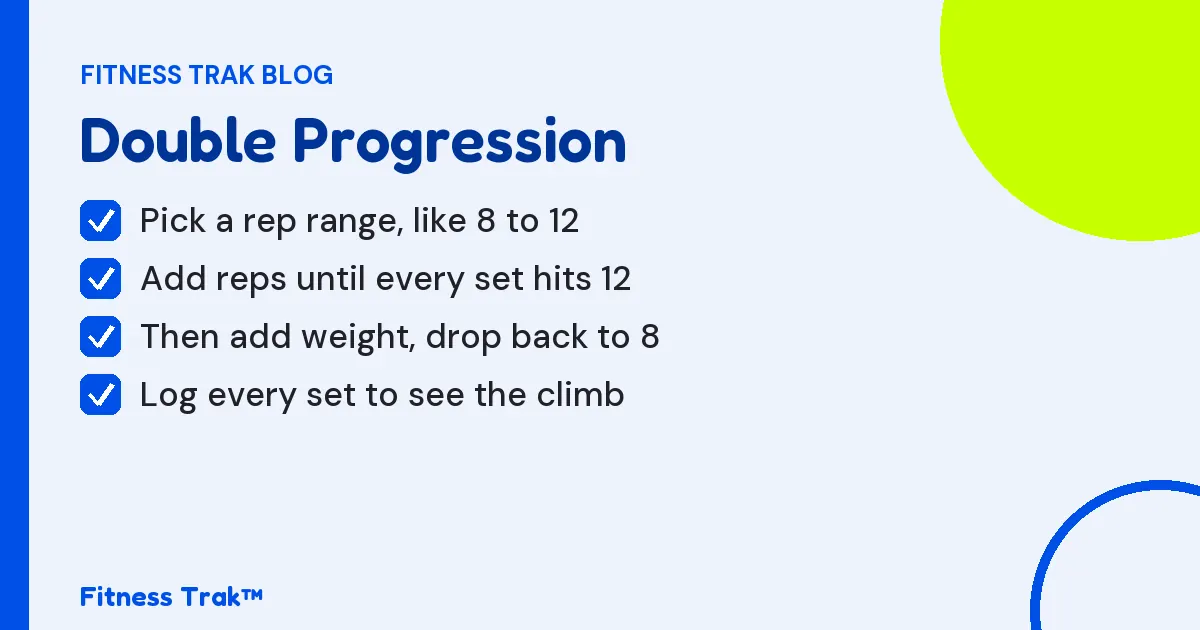
Double progression moves two things, one after the other. First you add reps with the same weight. When you reach the top of a set rep range, you add weight and drop back to the bottom of the range. Then you build the reps back up.
For example, take a range of 8 to 12 reps for 3 sets.
- Week 1: 50 pounds for 8, 8, 8
- Week 2: 50 pounds for 10, 9, 8
- Week 3: 50 pounds for 11, 10, 10
- Week 4: 50 pounds for 12, 12, 11
- Week 5: 50 pounds for 12, 12, 12. Every set hit the top of the range.
- Week 6: 55 pounds for 8, 8, 8. Start the climb again.
Progress shows up every week, even when the weight stays the same. That is the appeal. You are always beating something.
Why It Works
The American College of Sports Medicine (ACSM) names progressive overload as a core principle of resistance training. You can apply overload by adding weight, reps or sets. Double progression uses two of those in a fixed order, so the decision is made for you.
It also fits ACSM's own rule for adding weight. The position stand recommends a 2 to 10% load increase once you can do the current weight for one to two reps over your target on two consecutive sessions. Double progression builds in that same idea. You earn the weight jump by beating the reps first.
ACSM also suggests loads around 60 to 70% of your one-rep max for 8 to 12 reps for novice and intermediate lifters. That is why 8 to 12 is such a common range. If you are not sure what your one-rep max is, our guide on estimating your one-rep max without maxing shows a safe way.
Double progression vs linear progression
Linear progression adds weight on a set schedule, such as 5 pounds every session, with the same reps each time. It moves fast for beginners. It also stalls fast, because no one can add 5 pounds forever.
Double progression moves slower on paper, but it gives you more room. A rep is a smaller step than a plate. That makes it a good fit for:
- Lifters who have stalled on linear progression
- Small muscle exercises, like curls and lateral raises, where the smallest plate is a big jump
- Dumbbell and machine work, where the weight steps are fixed
- Home gyms with limited weights
Many lifters use both. Linear progression on a few main barbell lifts while it lasts, and double progression on everything else.
Steps
- Choose the exercise and rep range. A range of 8 to 12 works for most accessory lifts. Heavy compound lifts often use a lower range, such as 4 to 6 or 6 to 8.
- Pick a starting weight. Choose a weight you can lift for the bottom of the range on every set with good form and a rep or two left in reserve.
- Log every set. Write the weight and the reps you actually did. Without the last session in front of you, you can't know which number to beat.
- Add reps each session. Try to beat last time by at least one rep on at least one set. Keep the weight the same.
- Add weight when every set hits the top. Use the smallest jump your equipment allows. ACSM suggests 2 to 10%, with smaller jumps for small muscles and larger jumps for big lifts.
- Drop back to the bottom of the range. With the new weight, start over at the low end and build again.
- Review when you stall. If you can't add a rep for two or three weeks, check sleep and recovery first. Then try a smaller weight jump, or a lighter week.
Common Mistakes
- Range too narrow. A range of 8 to 9 leaves no room to climb. Give yourself at least three or four reps.
- Jumping weight too early. If you add weight after one set hits 12, the next session often collapses. Wait until every set reaches the top.
- Sloppy reps to hit the number. A rep with half the range of motion does not count. Keep form the same so the numbers mean something.
- Not writing it down. Double progression depends on exact rep counts. "About 10" isn't good enough.
How to log double progression
Your log needs the weight and the reps for every set, plus the rep range you are working in. A note on effort helps too. Our guide on logging RPE and reps in reserve explains a simple scale. For a full list of fields, see what to write in a workout log.
If you would rather not do the math, an app can do it. In Fitness Trak, routines support double progression, so you can build a rep range into the plan for each lift. The next set is filled in from last time, and each exercise has its own chart, so the climb is easy to see. Routines can also use deloads, schedule days and a % of your best. See everything it tracks. Fitness Trak is coming soon to the App Store and Google Play.
For the bigger picture on adding load over time, see how to track progressive overload.
Frequently asked questions
What rep range should I use for double progression?
A range of 8 to 12 reps is common for accessory and muscle-building work, and ACSM's guidance lists 8 to 12 reps for novice and intermediate lifters. Heavier compound lifts often use lower ranges, such as 4 to 6 or 6 to 8.
How much weight should I add after hitting the top of the range?
Use the smallest jump your equipment allows. ACSM recommends a 2 to 10% increase, with the smaller end for small muscle exercises and the larger end for big lifts like squats.
Is double progression good for beginners?
Yes. It is simple to follow and makes progress visible every week. Some beginners prefer linear progression on main lifts first and switch to double progression when they stall.
Should every set hit the top of the range before I add weight?
That is the most common rule, and it is the safer one. Some lifters add weight once the first set reaches the top, but that often leads to a hard drop in reps on later sets.
Sources
- American College of Sports Medicine position stand. Progression models in resistance training for healthy adults (PubMed)
- CDC, Physical Activity Guidelines for Adults