 Fitness Trak™
How To Log RPE And Reps In Reserve For Every Set
Weight and reps tell you what you lifted. They don't tell you how hard it was. A set of 8 at 185 pounds can be easy on a good day and a grind after a bad night. RPE and reps in reserve fill that gap with one extra number.
This guide explains both scales, how they connect, and how to log them without slowing down your workout.
What RPE Means
RPE stands for rating of perceived exertion. In lifting, it is usually a 1 to 10 scale for how hard a set felt. The version most lifters use today ties each number to how many more reps you think you could have done. That link comes from work by Zourdos and colleagues, published in the Journal of Strength and Conditioning Research in 2016, and a follow-up paper by Helms and colleagues on putting the scale into practice.
What reps in reserve means
Reps in reserve, or RIR, is the number of reps you had left when you stopped the set. If you did 8 reps and think you could have done 2 more with good form, that is 2 RIR.
How RPE And RIR Line Up
On the reps-in-reserve based RPE scale, each step down from 10 adds one rep left in the tank:
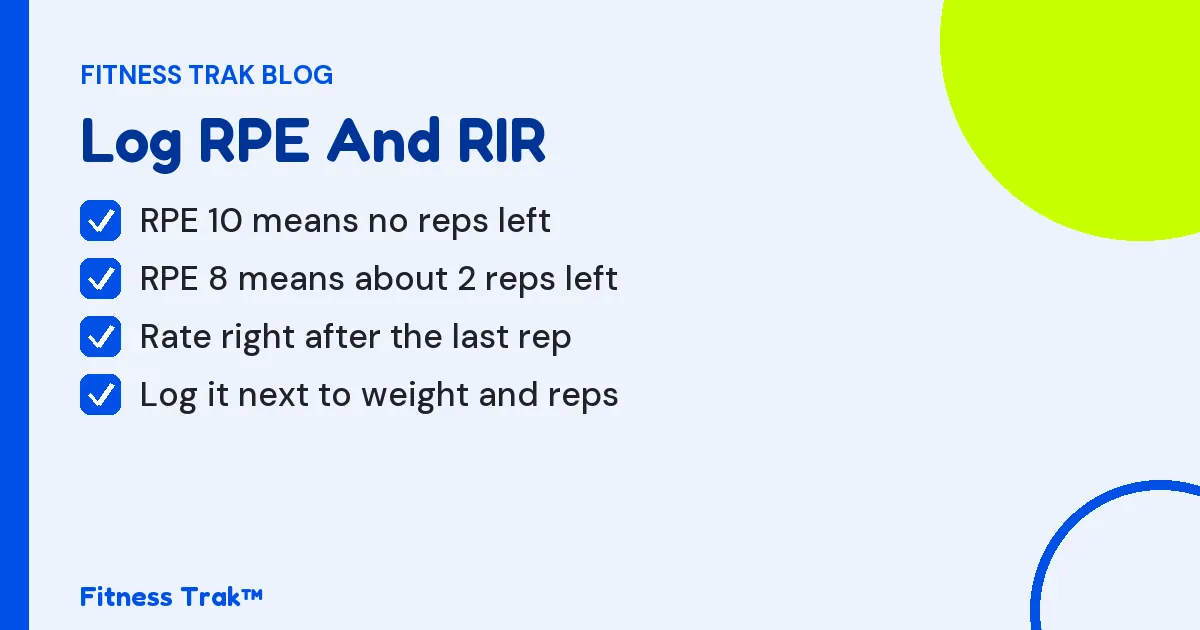
- RPE 10: no reps left. You could not have done another rep.
- RPE 9: 1 rep left.
- RPE 8: 2 reps left.
- RPE 7: 3 reps left.
- RPE 6 and below: 4 or more reps left. This is light, warm-up style effort.
Half points are common too. RPE 8.5 means you might have done 2 more reps, and definitely had 1 more.
So "RPE 8" and "2 RIR" mean the same thing. Use whichever feels easier to say. Pick one and stick with it, so your log stays consistent.
Why track effort at all
- It explains bad days. If your reps dropped but the RPE was 10, you gave it everything. Sleep or stress may be the cause, not the program.
- It shows real progress. The same weight and reps at a lower RPE means you got stronger, even though the numbers on the bar did not change.
- It guides your next weight. If a set of 8 felt like RPE 6, you probably have room to add weight. If it felt like RPE 10, hold or back off.
- It keeps training sustainable. Many programs keep most working sets a rep or a few short of failure. RPE shows whether you are doing that.
How to rate a set
- Rate right after the last rep, before you rest. Effort feels lighter after a few minutes.
- Ask one question. How many more good reps could I have done? Then convert to RPE, or log the RIR directly.
- Be honest about form. A rep with broken form does not count as a rep you had left.
- Expect to be off at first. In the Zourdos study, lifters with about 5 years of training rated a true max closer to RPE 10 than novices did. Rating takes practice.
- Check yourself now and then. On a safe exercise, take one set to near failure and compare the reps you got with the reps you guessed you had left.
How To Log It
Write effort right after the reps. A simple format works on paper or in an app:
- Squat, 225 x 5, RPE 7
- Squat, 225 x 5, RPE 8
- Squat, 225 x 5, RPE 8.5
Three sets at the same weight and reps, rising effort. That pattern is normal as fatigue builds. If a month later the same sets read RPE 6, 7 and 7.5, you are stronger.
For warm-up sets, you can skip the rating. Mark them as warm-ups so they stay out of your working numbers. For a full list of fields, see what to write in a workout log.
Using RPE to pick your next weight
A simple rule many lifters use is to set a target RPE for each exercise, such as RPE 8. If you hit the reps under that target, add weight next time. If you go over it, hold. This pairs well with the double progression method. It also makes your estimated one-rep max more meaningful, because you know how close each set was to your limit. For the full picture, see how to track progressive overload.
Logging effort by voice
The hardest part of logging RPE is remembering to do it. Typing between sets is slow, and a number you plan to write down later is often lost.
Fitness Trak lets you say the whole set at once on iPhone. Say "185 for 8, RPE 8," and the set is filled in for you to check and save. On Android, you type the same words. Tap Set Done and the set saves at once and starts your rest timer. The big-button gym mode makes logging easy with sweaty hands, and warm-up, drop, failure and AMRAP sets are marked apart from working sets. See everything it tracks. Fitness Trak is coming soon to the App Store and Google Play.
Frequently asked questions
What does RPE 8 mean in lifting?
On the reps-in-reserve based scale, RPE 8 means you finished the set with about 2 reps left. You could have done 2 more good reps but chose to stop.
Is RPE or RIR better?
They measure the same thing on the modern lifting scale. RPE 8 equals 2 reps in reserve. Use whichever is easier for you to judge and log, and stay consistent.
Should every set be RPE 10?
Most programs do not ask for that. Many keep most working sets a rep or a few short of failure. Follow your program, and save RPE 10 sets for exercises where failure is safe.
How do I get better at rating RPE?
Rate every working set right after the last rep, and now and then test your guess by taking a set closer to failure on a safe exercise. In the original study of this scale, experienced squatters rated a true max closer to RPE 10 than novices did.
Sources
- Zourdos MC, et al. Novel resistance training-specific rating of perceived exertion scale measuring repetitions in reserve. Journal of Strength and Conditioning Research, 2016 (PubMed)
- Helms ER, Cronin J, Storey A, Zourdos MC. Application of the repetitions in reserve-based rating of perceived exertion scale for resistance training. Strength and Conditioning Journal, 2016