 Fitness Trak™
How To Estimate Your One Rep Max Without Maxing Out
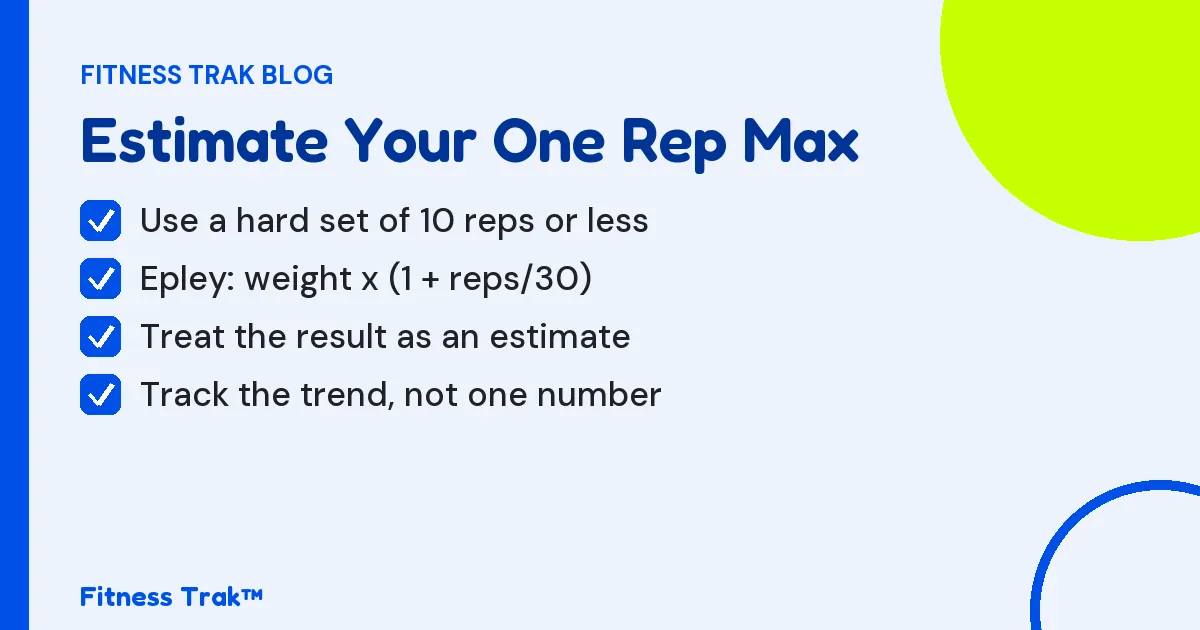
Your one-rep max is the most weight you can lift once with good form. Many programs are written as a percent of it. Testing it means a true all-out lift, which takes a long warm-up, a spotter, and a day when you feel strong. Most people don't need to do that.
You can estimate it from a normal working set. This guide shows two common formulas, how far to trust them, and how to use the number.
This is general information. If you have an injury or a health condition, ask your doctor or physical therapist before doing heavy sets.
The two most common formulas
Both formulas take the weight you lifted and the reps you did in a hard set.
Epley
Estimated 1RM = weight x (1 + reps / 30)
Example: 185 pounds for 8 reps. 8 divided by 30 is about 0.27. 185 x 1.27 is about 234 pounds.
Brzycki
Estimated 1RM = weight x 36 / (37 - reps)
Example: 185 pounds for 8 reps. 37 minus 8 is 29. 36 divided by 29 is about 1.24. 185 x 1.24 is about 230 pounds.
The two formulas stay within about 4% of each other up to 10 reps, and they meet at exactly 10. Above 10 reps they spread apart quickly. At 15 reps they differ by more than 8%.
How accurate are these estimates?
They are estimates, and you should treat them that way. A 1997 study by LeSuer and colleagues in the Journal of Strength and Conditioning Research tested seven prediction equations against real one-rep max tests in 67 untrained college students on the bench press, squat and deadlift. All seven equations underestimated the deadlift max by a significant amount.
A few things affect accuracy:
- Effort. The set has to be hard. A set of 8 you could have done for 12 will give you a low estimate.
- Reps. The formulas spread apart above 10 reps, so a high-rep set gives a shakier number. Keep the set at about 10 reps or fewer when you can.
- The lift. As the LeSuer study found, the formulas don't fit every exercise equally well.
- The person. Training history and muscle make-up change how many reps someone can do at a given percent.
The useful part is consistency. If you use the same formula on the same lift, a rising estimate means you are getting stronger, even if the exact number is off.
How to use your estimate
Plan your training weights
Many programs list weights as a percent of your max, such as 3 sets of 8 at 70%. ACSM's position stand suggests loads around 60 to 70% of one-rep max for 8 to 12 reps for novice and intermediate lifters. With an estimated max of 230 pounds, 70% is about 160 pounds.
Track strength without testing
Your estimated max changes when either the weight or the reps go up. That makes it a good single number for progress. A set of 185 for 8 and a set of 195 for 6 give nearly the same estimate, which tells you both sets show the same strength.
Spot a stall early
If your estimate is flat for several weeks on a lift you train often, it is time to change something. Our guide on how to track progressive overload covers what to adjust.
When a true max test makes sense
Some people want or need a real max, such as powerlifters before a meet. If you test, warm up well, use a spotter or safety bars, and stop if form breaks down. A true max carries more risk than a normal training set. If you are new to lifting or coming back from an injury, ask your doctor or physical therapist first, and stick with estimates.
Effort ratings make estimates better
A set to failure gives the clearest estimate, but you don't need to train to failure often. If you log how many reps you had left, using RPE or reps in reserve, you can still judge how close a set was to your limit. See how to log RPE and RIR. For lifts you progress with rep ranges, the double progression method pairs well with tracking an estimated max.
How Fitness Trak uses your estimated max
Fitness Trak does the math for you. A PR tag shows when a set beats your best weight, reps, e1RM or volume. Each exercise has its own chart. Routines can set weights as a % of your best, and plate math shows which plates to load from the plates you own. See everything it tracks. Fitness Trak is coming soon to the App Store and Google Play.
Frequently asked questions
What is the formula for one rep max?
There is no single formula. Two common ones are Epley, weight x (1 + reps / 30), and Brzycki, weight x 36 / (37 - reps). Both estimate your max from a hard set with a known weight and rep count.
How accurate is a one rep max calculator?
It gives a useful estimate, but it is not exact. A 1997 study found seven common equations all underestimated the deadlift max in untrained lifters. Use the estimate to track a trend, not as a precise number.
How many reps should I use to estimate my max?
Use a hard set of about 10 reps or fewer. The formulas drift apart above 10 reps, and the set needs real effort to mean anything.
Do I need to test my one rep max?
Most people don't. An estimate from normal training is enough to plan weights and see progress. Test a true max only if you have a reason, warm up well and use a spotter or safety bars.
Sources
- LeSuer DA, et al. The accuracy of prediction equations for estimating 1-RM performance in the bench press, squat, and deadlift. Journal of Strength and Conditioning Research, 1997
- American College of Sports Medicine position stand. Progression models in resistance training for healthy adults (PubMed)