 Fitness Trak™
How To Take Body Measurements And Progress Photos Right
The scale is the easiest number to track and often the least helpful one. It moves with water, food and time of day. If you are lifting to build muscle or training to lose fat, the scale can sit still while your body changes. Tape measurements and progress photos fill in what the scale misses.
They only work if you take them the same way every time. This guide shows how.
If you are tracking body changes for a health reason, or you have a history of disordered eating, talk with your doctor about what to measure and how often.
Why consistency beats precision
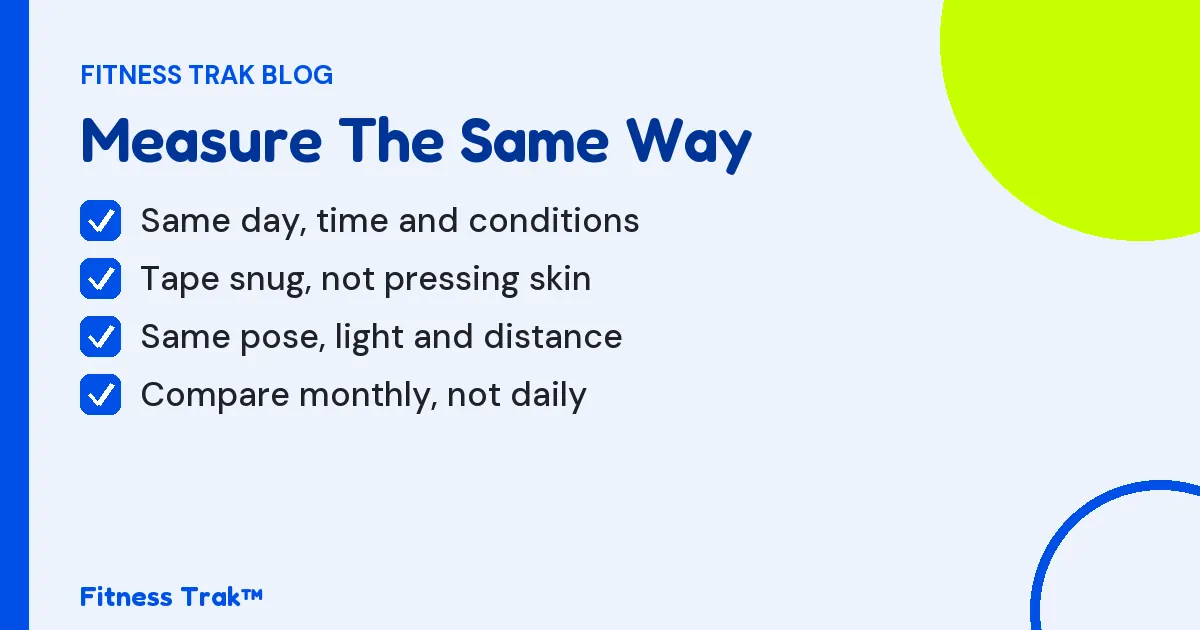
A tape measurement that is off by half an inch in the same direction every time still shows the trend. A measurement taken a different way each week shows nothing but noise. The same goes for photos. Different light, a different angle or a different time of day can make the same body look very different.
So the goal is to repeat the same conditions every time, more than to get a perfect number once.
Pick your conditions once
Before you start, decide on these and write them down:
- Day and time. Many people measure first thing in the morning, after using the bathroom and before eating.
- Clothing. The same clothes or none, every time.
- Frequency. Every 2 to 4 weeks is enough for tape and photos. Body changes are slow, and measuring daily mostly shows noise.
- Who measures. If someone helps you, use the same person each time.
Where To Measure
Common sites are below. Measure each one on bare skin with a flexible tape.
- Waist. The CDC describes measuring the waist by placing the tape around your middle just above the hipbones, keeping it snug without compressing the skin, and measuring just after you breathe out.
- Hips. Around the widest part of the buttocks, with feet together.
- Chest. Around the fullest part of the chest, under the armpits, tape level.
- Upper arm. Around the thickest part of the arm, relaxed or flexed. Pick one and always use it.
- Thigh. Around the thickest part of the upper leg while standing.
- Calf. Around the widest part of the calf while standing.
Measure the same side every time, or both sides if you want to compare them.
Steps
- Write down your conditions. Day, time, clothing and which sites you will measure.
- Find each site the same way. Use a landmark, such as the top of the hipbones for the waist, so you place the tape in the same spot.
- Keep the tape level and snug. It should sit flat on the skin without pressing in.
- Measure on an exhale. Breathe out normally and read the tape. Don't suck in.
- Take each measurement twice. If the two numbers differ, take a third and use the two that match.
- Record the numbers right away, with the date and the unit.
- Take your photos in the same session. Follow the photo steps below.
- Compare once a month. Look at the trend over several measurements, not one change.
How to take progress photos you can compare
- Same spot and same light. Pick a wall and a time of day. Daylight changes, so a room with steady light helps.
- Same distance and height. Put the camera on a shelf or tripod at about chest height, at a fixed distance. Mark your floor spot with tape.
- Same poses. Front, side and back is a common set. Stand relaxed, arms at your sides, for each one.
- Same clothes. Clothing changes how a body looks in a photo.
- Use a timer. A timer or remote lets you stand naturally instead of holding the phone.
Photos are private for most people. Keep them somewhere only you can see.
Reading The Results
- Waist down, weight flat. Often a sign of fat loss with muscle gain, if you are lifting.
- Arms, chest or thighs up with waist steady. Often a sign of muscle gain.
- Everything moving at once. Look at the trend over two or three months before changing your plan.
Body numbers sit best next to your training numbers. If your measurements change while your lifts climb, you can see both in one place. See how to track progressive overload and what to write in a workout log.
How Fitness Trak handles body data
Fitness Trak tracks body weight, body fat and tape measurements over time. Progress photos stay private in the app, and a ghost overlay of your last photo helps you line up the same pose. Body data, photos, injuries and sleep stay out of iCloud and Google backups. It never gives you a health score. Each person in your home can keep their own private profile on the phone, which our guide on tracking workouts for the whole family covers. See everything it tracks. Fitness Trak is coming soon to the App Store and Google Play.
Frequently asked questions
How do I measure my waist correctly?
The CDC describes placing a tape measure around your middle just above the hipbones, keeping it snug without pressing into the skin, and measuring just after you breathe out. Use the same spot and the same method every time.
How often should I take body measurements?
Every 2 to 4 weeks is enough for most goals. Body changes happen slowly, and measuring more often mostly picks up day-to-day noise from water and food.
What is the best time to take progress photos?
Pick a time you can repeat, such as first thing in the morning before eating. What matters most is using the same time, light, distance, pose and clothing every time.
Why are my measurements changing but my weight is not?
If you are lifting, you may be losing fat and gaining muscle at the same time, which can leave the scale flat. Look at measurements, photos and your lifts together over a few months. If you are unsure, ask your doctor.