 Fitness Trak™
How to Track Gym Progress So You Know You're Stronger
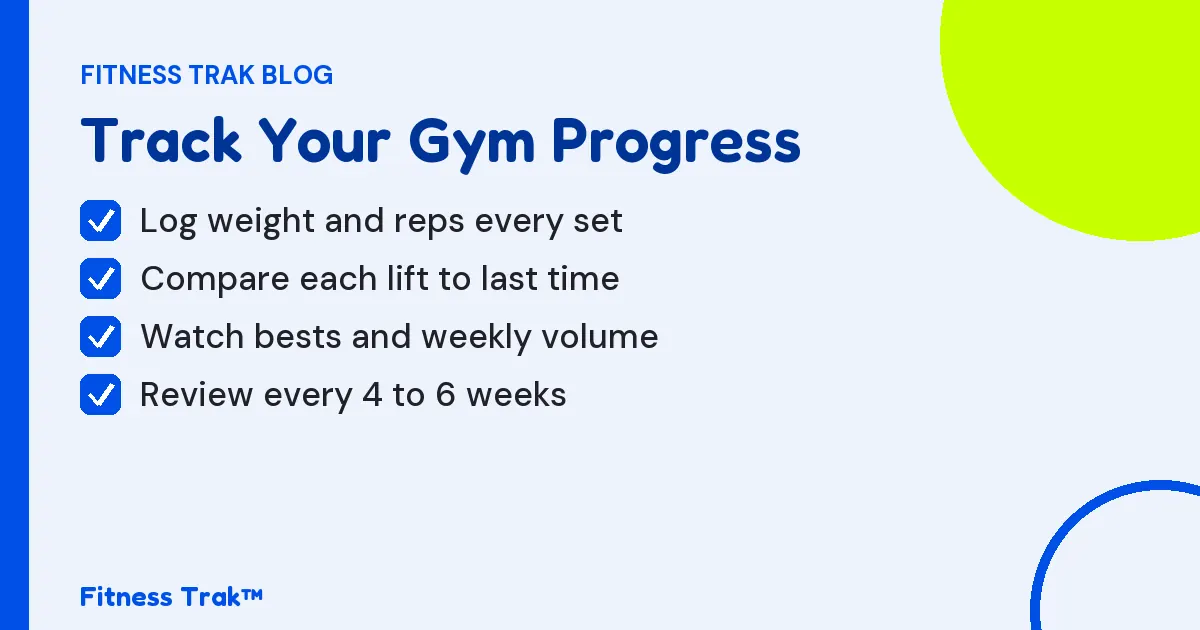
To track gym progress, write down the weight and reps of every working set, then compare each lift to the last time you did it. If you are slowly lifting more weight, doing more reps at the same weight, or doing the same work with less effort, you are getting stronger.
The trick is having the numbers in front of you when you train. Without a record, "what did I lift last time?" becomes a guess, and guessing stalls progress. Here is what to log, which numbers tell you the most, and how often to step back and look.
Why "feeling stronger" is not enough
Strength gains are slow. Week to week, a good day and a bad day can look more different than a month of real progress. Sleep, stress and food all change how a session feels. If you judge progress by feel, a single rough workout can convince you nothing is working.
Written numbers smooth that out. The American College of Sports Medicine's position stand on resistance training builds its progression advice on comparing sessions. It suggests adding 2 to 10 percent load when you can do one or two reps over your target on two sessions in a row. That rule only works if you can see your last two sessions.
What to log for each workout
You do not need much. For every working set:
- The exercise
- The weight
- The reps you actually did
- How hard it felt, if you track effort
Add the date, and mark warm-up sets so they do not mix in with working sets. Our full list of fields is in what to write in a workout log, and effort tracking is in how to log RPE and RIR.
Five numbers that show progress
Different numbers move at different speeds. Watch a few of them, so one stalled lift does not hide real gains elsewhere.
Weight at the same reps
The simplest sign. If you squatted 185 for 5 last month and 195 for 5 today, you are stronger.
Reps at the same weight
Often moves first. Going from 8 reps to 10 reps on the same bench weight is progress, even before the weight goes up. This is the idea behind the double progression method.
Estimated one rep max
A formula turns a set like 185 for 6 into an estimate of your one rep max. It lets you compare a heavy set of 3 to a lighter set of 8 on the same scale. Our guide to estimating your one rep max explains how and where the estimates go wrong.
Volume
Weight times reps times sets for a lift or a session. Rising volume over weeks is a sign you are handling more work. It is most useful for muscle growth goals.
Effort at the same load
If 135 for 8 felt like a 9 out of 10 a month ago and feels like a 7 now, you got stronger even though the numbers on paper look the same.
Steps
- Pick the main lifts you care about, usually three to six exercises.
- Log weight and reps for every working set in every session.
- Before each set, look at what you did last time on that lift.
- Try to beat last time by one rep or a small weight jump, while keeping good form.
- Mark a new best when a set beats your previous top weight, reps or estimated max.
- Every 4 to 6 weeks, look at each main lift and ask whether it moved up.
- If a lift has not moved in three weeks or more, change one thing, such as the rep range or a planned lighter week.
How often to review
Look at the last session before every set. That is how you make the next small step. Then do a bigger review every 4 to 6 weeks, at the end of a training block. At that point, ask simple questions:
- Which lifts went up?
- Which stayed flat?
- Did I miss sessions?
- Did any pain or injury get in the way?
Flat lifts are information, not failure. They tell you where to change the plan. For ideas, see how to track progressive overload. A planned easier week can also help a stalled lift, which we cover in what a deload week is.
Other signs of progress
Strength is not the only thing that changes. Body measurements and photos show changes the scale can miss. Cardio fitness shows up as a faster pace at the same effort. Consistency itself is progress. Training three times a week for six months beats any perfect plan you only follow for two.
Our guide on how to take body measurements and progress photos covers how to make those comparisons fair.
Paper, spreadsheet or app
Any of them works if you use it every time. A notebook is fast and never runs out of battery, but you have to flip back to find last week's numbers. A spreadsheet is good for charts, but awkward to type into between sets. An app can show last time's numbers in line and mark bests for you.
Fitness Trak was built for this. The next set is prefilled from last time, last session's sets show in line, and tapping Set Done saves the set and starts your rest timer. PR tags appear when a set beats your best weight, reps, estimated one rep max or volume, and every exercise has its own chart. A weekly goal with a week streak keeps rest days safe, so taking a day off does not break the streak. See the full list of what Fitness Trak tracks.
Frequently asked questions
How do I know if I am making progress at the gym?
Compare each lift to past sessions. If you can lift more weight for the same reps, more reps at the same weight, or the same set with less effort, you are making progress. Look at trends over 4 to 6 weeks instead of single sessions.
How long does it take to see strength gains?
It varies with training history, sleep, food and the plan. Many beginners see their lifts rise from week to week in the first months. More experienced lifters gain more slowly, so a monthly comparison shows progress better than a weekly one.
Should I track every set or just my top set?
Track every working set if you can. Your top set shows peak strength, but the other sets show volume and whether you held your reps. Mark warm-up sets separately so they do not distort your numbers.
What should I do if my lifts stop going up?
First check sleep, food and missed sessions in your log. If those look fine, change one variable, such as a new rep range, a smaller weight jump or a planned lighter week, and track whether the lift moves again over the next few weeks.