 Fitness Trak™
How To Track Running Shoe Mileage And Know When To Replace
Most runners can tell you their last 5K time. Few can tell you how many miles are on the shoes they wore for it. That number matters. Worn shoes can feel flat long before the outsole looks bad, and many runners only notice when their legs start to complain.
Here is what the guidance says about shoe life, what counts toward the total, and how to keep the number without thinking about it.
How many miles do running shoes last?
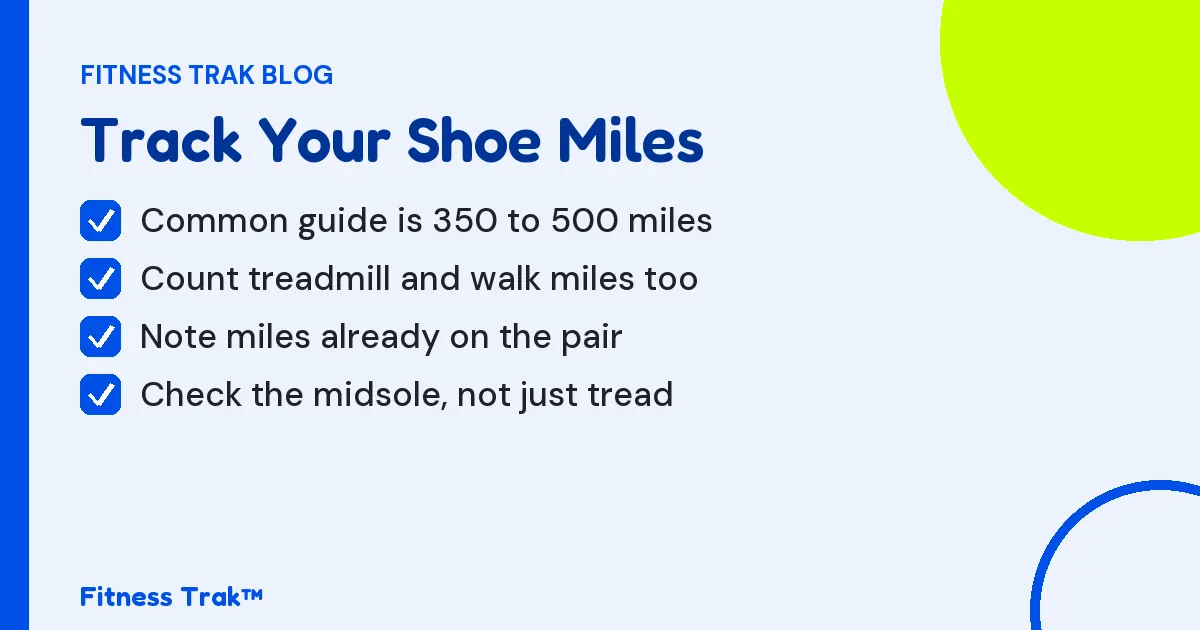
The American Academy of Podiatric Sports Medicine (AAPSM) says a typical running shoe should be replaced every 350 to 500 miles. It adds that the number depends on the runner. Heavier runners and hard heel strikers should plan to replace shoes closer to the 350 mile end.
Retailers and shoe brands often quote a similar 300 to 500 mile range. Treat these as guidelines. No single number fits every shoe, every body and every surface.
Things that can shorten a shoe's life:
- Body weight. More load per stride means more wear on the foam.
- Running style. Hard heel striking wears certain areas faster.
- Shoe type. Light racing shoes often have less foam to wear through than cushioned daily trainers.
- Surface. Rough pavement is harder on outsoles than a track or treadmill.
Signs a pair is done
Mileage tells you when to start looking. Your shoes and your legs tell you the rest. Common signs include:
- The midsole looks creased or compressed, or feels less springy when you press it.
- The outsole is worn smooth in spots, especially at the heel or forefoot.
- Your legs feel more beat up after runs that used to feel easy.
New aches can have many causes. If pain sticks around, see a doctor or physical therapist instead of assuming new shoes will fix it.
What counts toward the total
This is where most people undercount. Every mile on the shoe wears it, wherever you ran.
- Treadmill runs. They don't show up on a GPS map, but the foam is still compressing. Some apps only add miles from GPS runs, so treadmill miles go missing.
- Walking. If your running shoes are also your errand shoes, those miles count.
- Warm-ups and cooldowns. A mile jog before a race and a mile after adds up across a season.
- Miles already on the pair. If you start tracking halfway through a shoe's life, enter the miles it already has. Otherwise your count starts at zero on a half-worn shoe.
Three ways to track shoe miles
Write it on the box or inside the tongue
Write the date you bought the shoes on the tongue with a marker. It gives you age, though not miles. It is better than nothing, and useless if you run different distances each week.
Add it to your running log
If you already log runs, add a "shoes" field to each entry. At the end of each month, total the miles for each pair. This works well on paper or in a spreadsheet, as long as you never skip the field. Our guide on what to write in a workout log shows how to fit it in with your other fields.
Let your training app add it up
The easiest method is an app that assigns each run to a pair and keeps a running total. Check that it counts treadmill runs and lets you enter miles already on the shoe. Those are the two gaps runners mention most on forums.
Rotating Shoes
Many runners keep two or more pairs in rotation, for example a cushioned shoe for long runs and a lighter pair for faster days. Rotation means each pair gets fewer miles per week, so each one lasts more weeks. It also makes tracking more important, because you can't guess which pair has more miles.
A rotation is also a good habit for anyone in a busy home. If two people run, label the shoes and the log, so one person's miles don't end up on the other's pair. See our guide on tracking workouts for the whole family.
How Fitness Trak handles shoe miles
Fitness Trak tracks shoe and gear miles for you. Treadmill runs count, and you can enter the miles already on a pair when you add it. You log runs in miles or kilometers, and each of the 44 cardio types shows only its own fields. It also keeps your races with the entry fee and refund deadline, so race day planning lives in one place. See everything it tracks. Fitness Trak is coming soon to the App Store and Google Play.
A simple shoe routine
- When you buy a pair, write down the date and the starting miles.
- Assign every run and long walk to a pair.
- Check the total once a month.
- Around 300 miles, start checking the midsole and how your legs feel after runs.
- Buy the next pair before the old one is done, so you can break it in on shorter runs.
Frequently asked questions
How many miles should running shoes last?
The American Academy of Podiatric Sports Medicine says a typical running shoe should be replaced every 350 to 500 miles. Heavier runners and hard heel strikers may need to replace them closer to 350 miles. Use the number as a guide and check the shoe and how your legs feel.
Do treadmill miles count toward shoe mileage?
Yes. The shoe's foam compresses with every stride, indoors or out. Add treadmill runs to the same total as your outdoor runs, even if your watch or app does not record them by GPS.
Should I replace running shoes by months or by miles?
Miles are the better measure because people run very different amounts. Age still matters a little, so check older pairs even if the mileage is low. If you don't track miles, start now and enter your best estimate of the miles already on the pair.
Can I use old running shoes for walking or the gym?
Many people do. Keep them out of your running total once you retire them, and log the new pair from its first mile so the count stays accurate.
Sources
- American Academy of Podiatric Sports Medicine, When should I replace my running shoes?
- CDC, Physical Activity Guidelines for Adults