 Fitness Trak™
How To Track Physical Therapy Exercises At Home Every Day
Your physical therapist hands you a sheet of exercises and says "do these at home." Then life happens. A week later you are back in the clinic and they ask how it went. Did you do them five days or two? Did the shoulder hurt more on Tuesday or Friday? Most people can't say.
A simple log fixes that. It helps you stick with the plan, and it gives your PT real information to work with. This guide shows what to record and how to keep it going.
This is general information, not medical advice. Your doctor or physical therapist decides what exercises you do, how often and how hard. Follow their instructions and ask them before changing anything.
Why home exercise is hard to keep up
Home programs depend on you. Nobody counts your reps or reminds you to start. A systematic review of 30 studies in Disability and Rehabilitation looked at what predicts whether people keep doing home-based physical therapy. The factors with the strongest evidence included the person's intention to exercise, self-motivation, confidence in their ability to do the exercises, past exercise habits and social support.
A log can't create motivation out of nothing. It can make the plan visible, show you a streak of days done, and turn "I think I did them" into a record you can trust.
What To Record
Keep the log close to how your PT wrote the plan. For each exercise, track:
- The exercise name exactly as your PT wrote it, so you both mean the same thing.
- Sets and reps, or the hold time for stretches and isometric holds.
- Side, if you work left and right separately.
- Weight or band color, if any.
- A pain rating, using the scale your PT gave you. Many clinics use 0 to 10. Ask your PT which number they want you to stay under.
- A short note, such as "clicking at the top" or "easier than Monday."
Also log the injury itself once, with the date it started and how it happened. That context helps when you look back.
Steps
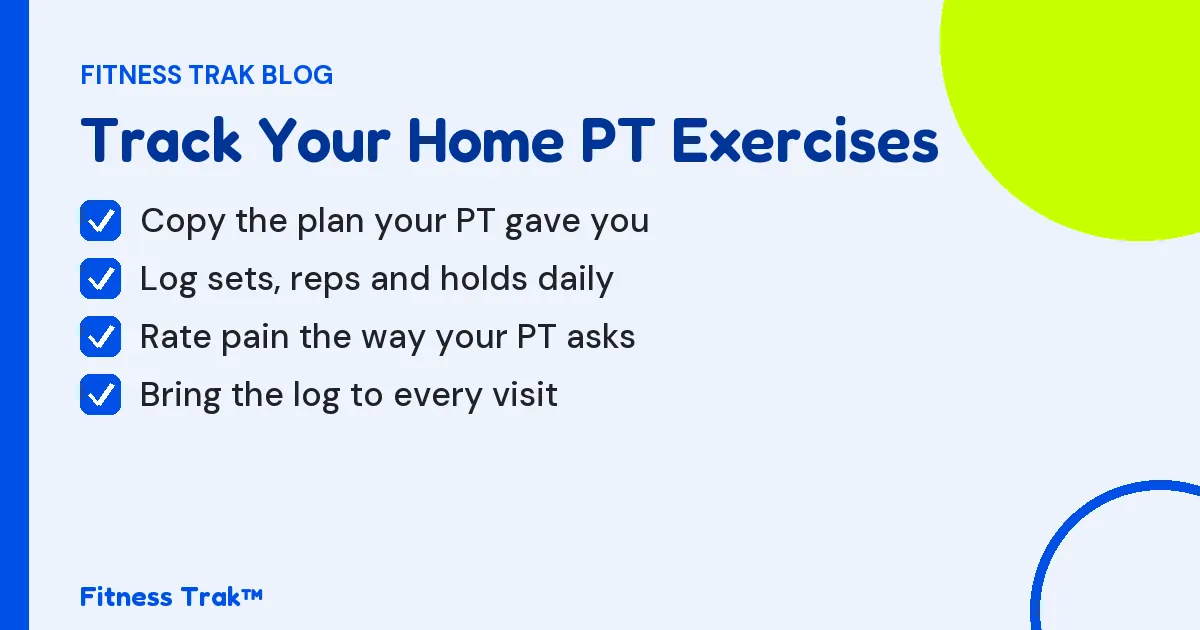
- Copy the plan on day one. Enter every exercise from your PT's sheet with its sets, reps and holds. Take a photo of the sheet too, so you can check the details.
- Pick a fixed time. Tie the exercises to something you already do every day, like after breakfast. A fixed slot is easier to keep than "sometime today."
- Log right after each session. Record what you actually did, including missed sets. An honest log is more useful than a perfect one.
- Rate pain the same way each time. Use your PT's scale and rate at the same point, such as right after the last set.
- Write down questions as they come up. If something hurts in a new way, note it. Call your PT or doctor if you are worried. Don't wait for the next visit.
- Bring the log to your appointment. Show your PT the days done, the pain ratings and your notes. Let them decide on any changes.
Make the log easy to read
Your PT has limited time in each visit. A clear log helps them see patterns fast.
- Group by week. "5 of 7 days" is easier to scan than a list of dates.
- Keep pain ratings in one column. A trend from 6 down to 3 is a useful thing for your PT to see.
- Mark changes. If your PT adds an exercise or raises the reps, note the date. Otherwise you can't tell why the numbers moved.
If you lift or run while you recover, keep those workouts in the same place as your rehab. Your PT may want to know what else you did that week. A workout log with all your training in one spot makes that easy to share.
When you are back to regular training
Once your PT clears you, keep the log going. Many people restart lighter and build up again. Tracking the return lets you see that steady climb instead of guessing. Our guide on tracking progressive overload covers how to build back up in a measured way, within the limits your provider sets.
Where Fitness Trak Fits
Fitness Trak keeps rehab next to the rest of your training. You can log an injury with pain ratings, and your provider's home exercises show up on the Today screen so they are hard to forget. You can export a PT file of what you did to share at your visit. Fitness Trak never gives medical advice and never tells you what exercises to do. It shows the plan you or your provider set. See all the areas it covers. Fitness Trak is coming soon to the App Store and Google Play.
Frequently asked questions
How often should I do my home physical therapy exercises?
Follow the schedule your physical therapist gave you. Programs differ a lot by injury and stage of recovery, so there is no single right number. If the plan is unclear, call your PT and ask before guessing.
Is some pain normal during home exercises?
Ask your physical therapist or doctor. Many PTs give a pain level they consider acceptable during exercise, and a level that means stop. Record your ratings and report any new, sharp or worsening pain to them.
What should I bring to my next PT appointment?
Bring your log with the days you did the exercises, the sets and reps, your pain ratings and any questions you wrote down. That gives your therapist facts to adjust the plan instead of memory.
Can I keep lifting or running while doing PT?
That depends on your injury, so ask your physical therapist or doctor. If they clear some training, log it alongside your rehab so they can see the full picture of your week.
Sources
- Essery R, et al. Predictors of adherence to home-based physical therapies: a systematic review. Disability and Rehabilitation (PubMed)
- CDC, Physical Activity Guidelines for Adults